Two Accounts, One Event: Comparing Sources Without Picking a Winner
Compare sources without picking a winner by tracing each claim to its basis and seeing which parts of an event each account can actually establish.
Two accounts of the same event can disagree because their speakers had different access to the evidence. To compare sources without picking a winner, ask what each account rests on: direct observation, a document, an unnamed source, or someone else’s description. That question reveals which parts of the story each account can actually establish.
Separate claims from support
Begin by splitting each account into individual claims. “The meeting ended early” describes an observable event; “officials ended it to avoid criticism” adds a claim about motive. The second statement needs a different kind of support than the first.
For every claim, note the evidence offered and how closely it connects to the point being made. A meeting notice can establish the scheduled time, but it cannot establish why the meeting ended. A recording might capture when people left, but not what prompted them to go.
Trace the evidence path
Follow a claim backward to its nearest available basis. A news story may cite an agency statement, which may cite a report; a second story repeating the first does not create a separate line of support. The origin matters more than the number of times a claim appears.
Record the source and the route by which the information reached it. These questions help distinguish separate evidence from repeated wording:
- Direct observation: Did the speaker see or hear the specific event, or describe what someone else reported?
- Document: Is the relevant record available, and does it contain the detail being claimed?
- Recording: Does the audio or video cover the relevant place and moment, or leave a gap?
- Attribution: Does the account name its source, describe the source’s access, or leave both unclear?
- Independence: Does another account draw on separate material, or repeat the same original source?
- Scope: Does the evidence support the whole statement, or only one piece of it?
Each item should lead to a decision, not a vague score. If a document is linked and its wording matches the claim, treat that detail as document-supported; if the link is missing, keep it attributed to the speaker rather than presenting it as independently confirmed. If two reports cite the same statement, count them as one evidence path and look for a separate record or observer.
Match evidence to claims
Different evidence is suited to different questions. A witness may be well placed to describe a conversation nearby, while a sign-in sheet may show who registered but not who stayed. An official statement can establish what an agency says it decided; a supporting record may show whether the stated procedure was followed.
Think of each piece of evidence as having a boundary. A photograph can show a visible condition from one angle, but not what happened outside the frame. A transcript can show recorded words, but may not preserve pauses, interruptions, or the setting in which they were spoken.
It is not worth treating every source as a courtroom exhibit. For a minor detail that does not affect the basic account, note the source and move on; reserve close tracing for claims about sequence, responsibility, or motive.
Work through a disagreement
Imagine a resident says a road closure began before the city announced it, while the city says traffic changes followed its notice. In this invented situation, the starting material is those two statements and a local traffic alert showing when drivers were redirected.
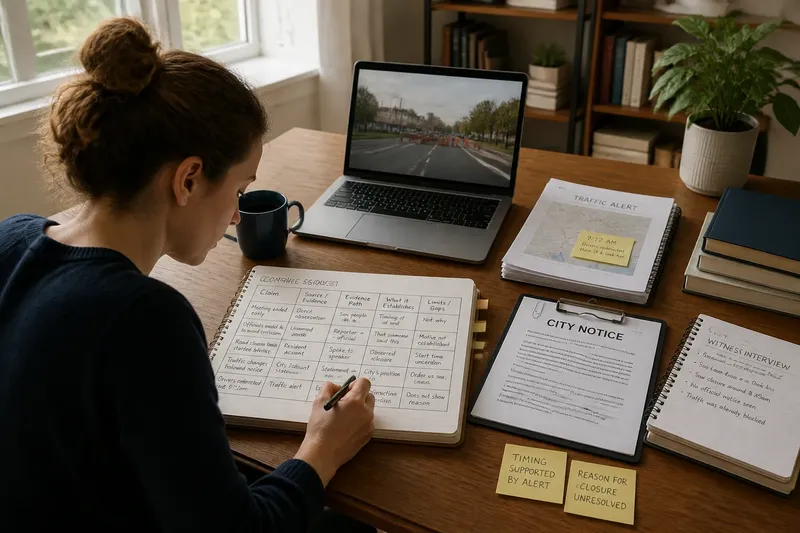
First, separate the claims: the resident speaks to the apparent start of the closure, the city describes the order of events, and the alert records a redirection. Next, check the alert’s timestamp and whether it identifies the location; if it does, use it to support the timing of the redirection, not the reason for the closure. Then seek the notice itself and any operational record that would establish when the closure took effect. If those records are unavailable, the result is a supported redirection time but an unresolved start time and cause—not a winner between the accounts.
What can each source establish?
Does a direct witness settle a dispute?
No. A witness can support what was visible or audible from their position, but may not know what happened elsewhere or why someone acted. Match the testimony to the witness’s actual opportunity to observe.
Can two reports count as independent support?
Only if they rely on distinct evidence paths. If both repeat one spokesperson’s statement, they document the circulation of that statement, not two separate confirmations.
What does an official document prove?
It can establish what the document says, who issued it, and perhaps what procedure or decision it records. It cannot automatically prove that every account of events described in it is complete or accurate.
What if the evidence supports only part of a claim?
State the supported part plainly and keep the rest open. For example, a timestamp may establish when a notice appeared without establishing when a decision was made.
Describe the limits
Be precise about what remains unsupported: “the recording starts after the exchange began” is more useful than calling the recording unreliable. A specific gap tells readers what additional evidence could matter.
When a source offers an interpretation as well as an observation, label the two separately. “The notice was posted before traffic was redirected” may be checkable against timestamps; “the notice caused the redirection” requires evidence of the decision process, not just sequence.
Keep a clear record
Use a notebook or a simple table to preserve each account’s claim, evidence path, and limits. When a document or statement adds a new basis, enter it separately rather than blending it into an earlier source’s account.
To compare sources without picking a winner, describe which evidence supports each detail and where its reach ends. A claim may be well supported as to timing while its cause remains unresolved. That distinction gives readers a clearer account of what the record can—and cannot—say.