A Five-Minute Check Before Sharing a Developing Story
Use a five-minute check before sharing a developing story to choose accurate wording, preserve context, and avoid passing along an unsupported claim.
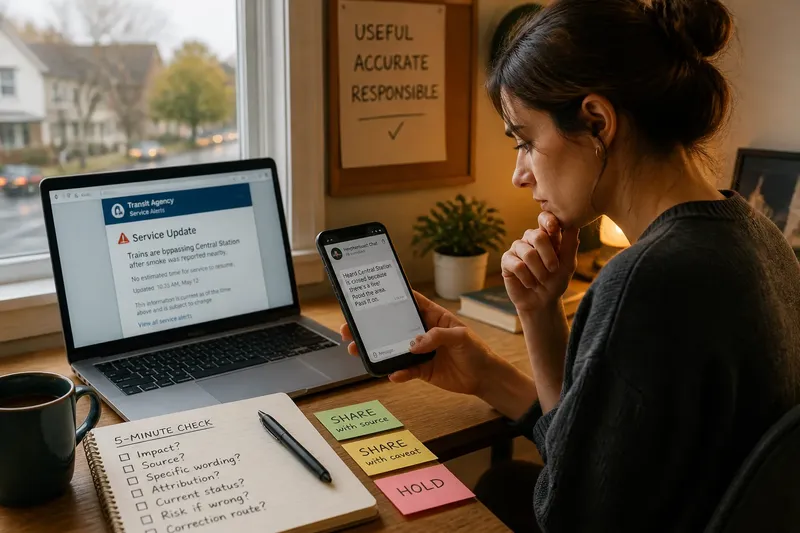
A five-minute check before sharing a developing story can change a group-chat message from a confident guess into a useful update. When a post claims a school is closed or a road is blocked, check what action readers might take before you forward it: the right choice may be to share a sourced notice, add a caveat, or wait.
This quick check is not a miniature investigation into everything that happened. Its job is to prevent a claim from becoming more certain, more dramatic, or more actionable as it moves from one person to another.
Check the claim’s impact
Start by asking what someone might do if they believe the post. A rumor about a public figure’s schedule may have little immediate effect; an unconfirmed road closure could send a neighbor on a detour, and an inaccurate evacuation message could cause real confusion.
Write the claim in one plain sentence, then identify its practical consequence. “The county says the library is closed today” is different from “the library is unsafe,” even if both appear in posts about the same place. If the stronger wording could prompt fear, blame, or a risky decision, do not repeat it without support.
Use a sharing decision
Before forwarding, sort the post into one of three actions: share the supported detail with attribution, share only after adding a clear limitation, or hold it. This decision is about the message’s immediate usefulness, not about settling the entire story.
- Source link: If the post links to a current original notice or report, open it and share that link; if it does not, search for the issuing organization’s own page or wait rather than forwarding a source-free claim.
- Specific wording: If the original says “service suspended,” use that wording; if your draft says “station closed because of a fire,” remove the unsupported cause or do not share that version.
- Attribution: If the report says an agency announced a decision, name the agency; if the claim comes from an unnamed repost, label it unverified or hold it.
- Current status: If the source has a newer update or correction, use the latest wording; if you cannot tell whether an old notice still applies, avoid presenting it as current.
- Practical risk: If readers could face danger, unfair blame, or a needless disruption by acting on the claim, wait for a responsible source; if the supported information is still useful, share only that narrow information with its limits.
- Correction route: If you can update the same place where people will see your post, share with a plan to correct it if needed; if you cannot make a correction visible, be more cautious about passing along an unsettled detail.
These choices are not a scoring system. One missing link can be enough to hold a post, while a clear official notice may be useful to share even if it leaves the cause unanswered.
Keep the claim narrow
A fast update often bundles several claims together: what happened, who is affected, why it happened, and what comes next. Treat each as a separate sentence in your mind. A source may support the first while leaving the rest open.
Imagine you receive a transit agency notice saying trains are bypassing a station after smoke was reported nearby. The source is the agency’s current service page, and the notice gives no cause or reopening time. You can share, “The transit agency says trains are bypassing the station after smoke was reported nearby; it has not posted a reopening time.” That sentence communicates the service change while avoiding an unsupported claim that there was a fire or a confirmed emergency.
Notice what the example leaves out: you do not need to identify the source of the smoke or predict when service will resume. Those details would make the post feel fuller, but they would not make it more useful unless a source supports them.
Follow the update trail
Developing stories can change between the first alert and the notice people are forwarding later. Open the link rather than relying on a screenshot, then look for a publication or update time, a correction, and any language that limits the report to a particular moment.
For a service alert, the transit agency’s service page may answer whether the disruption is still in effect. For a school notice, check the school district’s own channel before sharing a parent’s screenshot as current. A fresh-looking repost can still carry old wording, so let the source’s current page—not the post’s circulation—set the status.
If a correction appears, update or remove your message and make the correction visible in the same conversation or channel. A quiet edit may not reach people who already acted on the earlier wording.
What should you do next?
What if the source is unclear?
Do not pass the claim along as confirmed. Look for an original notice or a report that identifies its source; if neither is available, say that the post is unverified or wait.
What if the source is the only one?
A single source can support a narrow, attributed update without establishing every detail around it. Share only what that source can speak to, and wait if the unresolved part is the detail readers need to act safely.
Can I share a screenshot?
A screenshot may omit the link, date, context, or correction. Prefer the original page; if the image is the only material available, describe it as an unverified screenshot rather than treating its text as a current notice.
What if I already shared a false detail?
Correct it where people saw the original, state what was inaccurate, and link to the clearest current source. If the message could affect someone’s safety or reputation, make the correction especially visible rather than relying on a silent edit.
Skip the rumor hunt
It is not worth spending the pause trying to reconstruct every repost, identify every account that repeated the claim, or guess what an official source has not said. That work can distract from the decision in front of you: whether your specific message is accurate and useful now.
Use the five-minute check before sharing a developing story to choose a sentence that matches its source and current status. If you cannot make the wording both useful and supportable, waiting is a clear decision—not a claim about what will eventually prove true.